
Regulations for the operation of lifting equipment
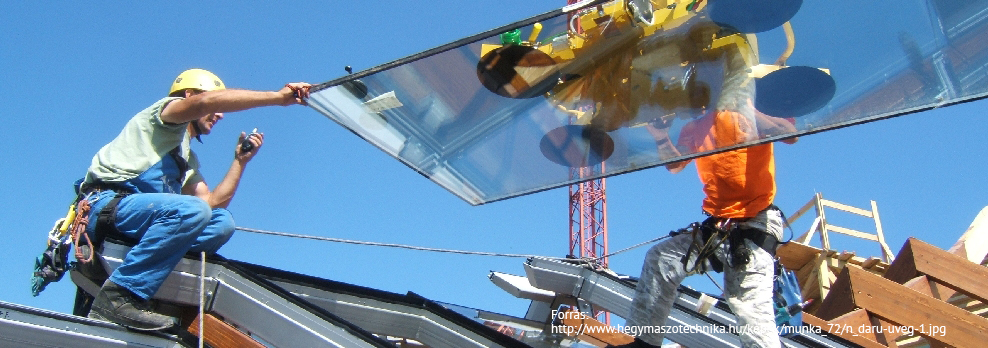
There are a few basic, universally valid regulations regarding the commissioning and downtime of lifting equipment. In general, however, we cannot speak of regulations for the work of these machines. In all cases, it is necessary to consult the machine manual. Similar to machine operation, it is important to adhere to safety equipment and regulations. Serious accidents can be prevented by applying these together. Here I have collected a few timeless truths to ensure safe work.
Regulations related to work
When operating lifting equipment, it must be checked that if more than one person has been assigned to tie (load) the load, one of them has been entrusted with directing the lifting equipment operator. Attention must be paid to whether the operator takes the following measures when leaving the lifting equipment at the end of its operation, or at the beginning of breaks:
- the load and the rigid load-handling device must be safely lowered;
- the lifting equipment must be brought into the position specified in the operating instructions;
- the control elements of the lifting equipment must be switched to the off position;
- for outdoor lifting equipment, protective measures against starting or moving due to wind load must be put in place;
- in the case of lifting equipment powered by an internal combustion engine (e.g., mobile), the engine must be shut down;
- the lifting equipment must be brought into the state prescribed for downtime in the operating instructions;
- it must be prevented that unauthorized persons can commission the lifting equipment.
Electric lifting equipment must be disconnected from the network during downtime, and the main switch must be locked in the off position with a safety lock (padlock). It must be checked that parts remaining under voltage after disconnection (enclosed cabinets, heating, anti-freeze resistors, safety lighting) do not cause fire. The electrical equipment for heating and ventilation of the operator's cabin must not remain under voltage.
If, due to extreme environmental effects (heavy snowfall, fog or other weather or environmental effects), the load or the immediate surroundings can no longer be observed during the entire transport process, or the control signals can no longer be clearly recognized, the operation of the lifting equipment must be stopped.
https://www.youtube.com/watch?v=GgNcQx3uaXc&embeds_referring_euri=https%3A%2F%2Farchphases.hu%2FOutdoor lifting equipment – unless the manufacturer specifies otherwise in the lifting equipment's operating instructions, its machine manual, or the assembly technology does not establish a lower limit – may only be operated up to a wind speed limit of 18 m/s.
For lifting equipment exposed to wind, it must be ensured that the lifting equipment is secured or protected against the moving, overturning, damaging effects of wind that may arise during downtime.
The installation and use of a wind speed meter are necessary for outdoor (even vehicle) cranes; its presence must be checked. The absence of a wind speed meter is only acceptable if the operator can prove that they have a contract with the Meteorological Service to receive an alarm in a timely and appropriate manner about a possible approaching wind, storm, etc. at the work site.
When performing lifts near public areas, i.e., if the lifting equipment is installed or operated near public roads, railway tracks, flight paths and airports, as well as waterways or routes (public areas), or within the radius of inhabited buildings, it must be examined whether the regulations of the owner, operator, or manager of the facility have also been taken into account (to reduce foreseeable risks), and whether the conditions for safe operation have been recorded in instructions.
In the case of lifting equipment set up with an impact on public areas, has the lifting technology instruction recorded at least the following:
- the type of lifting equipment designated for use, with the precise location of installation,
- the permitted lifting operations,
- the delineation of the operating area,
- the warning signs and control devices to be erected;
- additional safety devices and measures (e.g., gearbox disconnection or interlocking),
- traffic regulation, - diversion,
- the application of protective roofs.
If justified, the movement area and reach of the lifting equipment must be limited or electrically interlocked in the opposite direction to prevent danger to public areas. The fencing must be provided with color markings and adequate lighting in the dark. Lifting equipment must be designed so that the prescribed stability is maintained during operation and beyond, including transport, assembly and disassembly states, as well as foreseeable malfunctions and inspections carried out according to the operating instructions. Special attention must be paid here to lifting equipment that is regularly assembled and disassembled (e.g., construction tower cranes, mobile cranes).
https://www.youtube.com/watch?v=mNMKhSiT54oSafety devices:
For crane hooks, a basic safety device is the anti-snagging mechanism. Its application is prescribed by point 2.6 of MSZ12862:1980 standard if there is a risk of snagging. In the absence of an anti-snagging mechanism, the supervisor can only intervene if an anti-snagging mechanism was visibly present on the hook but fell off or broke. However, there are hooks on which the anti-snagging mechanism could only be mounted by drilling into the hook shank. This is FORBIDDEN, as it would reduce the load-bearing capacity of the hook!
Although not a safety device, it is still relevant and important to check whether the authorized load capacity is clearly and legibly marked on the work tool/lifting equipment used for lifting loads. It must also be checked whether lifting equipment used for lifting loads is operated in such a way that, taking into account the properties of the ground, the lifting equipment remains stable throughout the entire period of work. This can be done for mobile cranes by checking their outriggers (all mobile cranes must have appropriate load distribution pads, and the outriggers must function), and for construction tower cranes by checking the presence of a soil mechanical survey.
Another important issue is the inspection of the condition of the lifting rope and chain. In the case of a rope, if there are numerous broken elementary wires, strand breaks, birdcaging, kinking, etc., the use of the crane must be prohibited. In the case of chains, action must be taken in the event of visibly significant wear or deformation. A common fault in cranes is the malfunction of the limit switch that delimits the upper position of the hook; in mobile cranes, it is often forgotten to install it when extending the boom.
Safety equipment and regulations
Tools, structures, protective and auxiliary devices must comply with the requirements of relevant European, national or international standards.
Protective equipment generally used for work:
- insulating boots, gloves and galoshes;
- eye or face protection;
- head protection;
- appropriate protective clothing;
- insulating mat, platform and stool;
- flexible and rigid insulating protective grating;
- insulated tools and insulating devices;
- operating and insulating rods;
- locks, warning signs, symbols;
- protective covers, signal flags, other signaling devices.
Work regulations for other lifting structures
- It must be ensured that no one remains under the lifted load or in the danger zone during lifting and lowering.
- The load must be lifted in such a way that it does not collide with other objects.
- Only pulley blocks made of metal or material of equivalent strength that meet the required load and whose load capacity is clearly visible thereon may be used for lifting.
- The design of the pulley block must be such that the rope cannot jump out sideways. If the pulley block is designed so that the rope can only be placed on the sheave after moving a securing plate, that plate must be secured with an anti-rotation pin.
- Rope guidance must be ensured for pulley blocks.
- The pulley block must be secured with a wire rope or clamp. It is forbidden to secure the pulley block with soft iron wire.
- Only differential pulley blocks may be used where the pull rope is secured against jumping out, and the load can only be lowered by operating the pull rope. In differential pulley blocks, the hand pull rope must be secured so that the load does not fall if it slips out of hand.
- The pull chain or rope must be easily accessible from the operating level. In the case of an endless chain or rope, the lower end of the pulling element must not be higher than 50 cm from the operating level.
- The winch must be secured against displacement, taking into account the forces.
- For winches, the hoisting rope must be guided at an angle of 30° or less to the ground; for rope guidance steeper than 30°, calculated anchorage must be used.
- If the winch cannot be reliably anchored to the ground or foundation, it must be secured against lifting by ballasting, against sliding by pegging, or by tying back. The ballast weights required according to calculation must be placed and secured so that they cannot move.
- When lifting with a winch, the hoisting rope must only be guided or loaded with safely fixed guide elements intended for this purpose.
- For hand-operated winches, the load must stop both during lifting and lowering if the crank handle is released. Lowering the load – if there is no speed limiter device and disengageable crank handle – can only be done by rotating the crank handle backward.
- For crank winches, the crank handle must be prevented from snapping back. If the device preventing snap-back is not automatic, the operator must set it before starting work.
- The jack may only be used for vertical lifting and with an intact pawl lock, or a device providing equivalent safety.
- The jack must be placed on a foundation of sufficient strength for the load, so that it cannot move or tip over during lifting.
- Before starting lifting, the safe placement of the load on the jack's support structure must be checked.
- When operating the jack, the lifted load must be observed. When lowering, all objects must be removed from under the load or the moving parts of the jack.
- It is only permitted to step on, stay on, or work on a lifted load if it is ensured that:
- the load will not tip or slide as a result;
- safe access and descent are provided.
- It is forbidden to stay on the load during lifting and lowering!
- When assembling on a lifted load, it must be ensured that the distribution of the load does not change to such an extent as to jeopardize its stability by removing or installing components or parts.
- When lifting with multiple jacks, the load distribution at each lifting point must be checked.
- If the load only partially separates from the ground during lifting, the part of the load remaining on the ground must be secured against displacement.
- In the case of loads lifted outdoors, the potential danger from wind effects must also be considered.
- The height of the jack's support elements may only be increased with an extension piece that is part of the jack's accessories.
Summary:
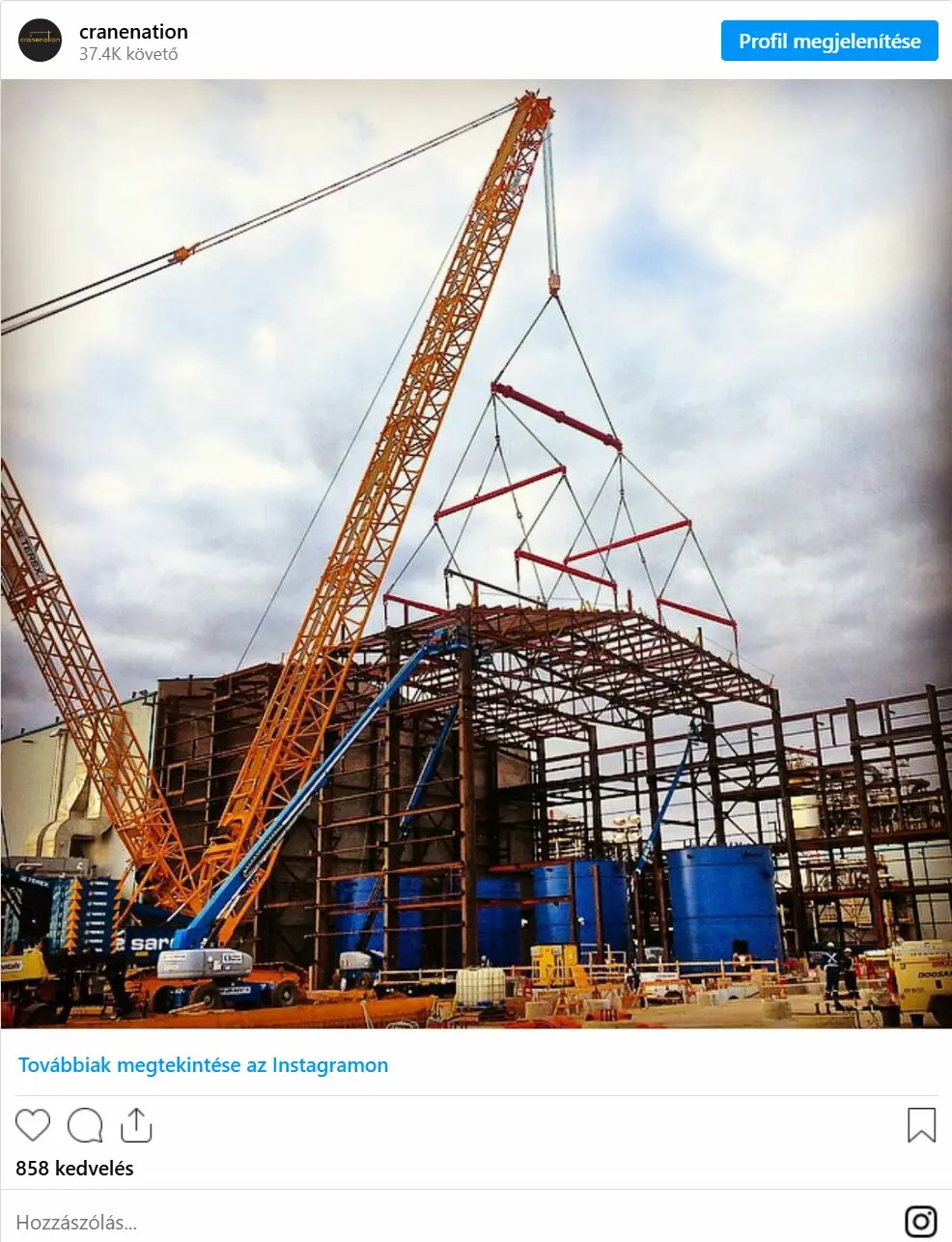
It can be stated that quite a few safety regulations must be observed when operating lifting equipment. Therefore, it is always advisable to consult the machine manual. There are also general truths here that are worth considering.
Sources:
BME Department of Building Construction, Lecture notes on Organization of Structures Assembly
YBL lecture notes